Microprocessors and -controllers
audiobook of data sheet ATtiny212_412
recitation
presentation
literature explaining working with AVRs
microcontroller vs -processor
MCU
An MCU is a group of microcontroller units that share a common architecture, design, and often the same core features
ARM Cortex-M is a popular MCU family, where multiple manufacturers like STMicroelectronics, NXP, and Microchip produce MCUs that are based on the ARM Cortex-M core.
AVR is another MCU family, famously used in the Arduino platform.
PIC is a family of MCUs from Microchip Technology, with a range of devices from small 8-bit controllers to more powerful 16-bit and 32-bit versions.
Within each MCU family, you’ll typically see models that differ by features like:
Flash memory size
RAM size
Clock speed
Number of GPIO pins
Peripheral support (e.g., UART, SPI, I2C, timers, etc.)
In-System Programming (ISP)
the act of programming a microcontroller while it is already mounted on the board
Contrary to Pre-Programming. You program the contro
CMSIS-DAP Devices are all devices that can write programs into a microcontroller's memory using JTAG or SWD.
ler before soldering it somewhere.
Available Controllers
At least 5 of each:
SEEEDSTUDIO XIAO SAMD21 NO HDRS
SEEEDSTUDIO XIAO ESP32C3 NO HDRS
SEEEDSTUDIO XIAO ESP32S3 NO HDRS
SEEED STUDIO XIAO RP2040 ARDUINO
ATSAMD11C14A-SSUT
ATSAMD21E18A-AUT
ATTINY412-SSFR
ATTINY1624-SSFR
ATTINY3226-SU
AVR128DB32-I/PT
Xiao RP2040
Pico RP2040
ESP32C3
ESP32S3
SAMD21
ATSAMD11C14A-SSUT
ATSAMD21E18A-AUT
ATTINY412-SSFR
ATTINY1624-SSFR
ATTINY3226-SU
AVR128DB32-I/PT
Type
ARM Cortex-M0+
ARM Cortex-M0+
ARM Cortex-M0+
ARM Cortex-M0+
Frequency
133MHz
133MHz
160 MHz
240 MHz
48MHz
48MHz
48MHz
20MHz
20MHz
20MHz
24MHz
SRAM
264KB
264KB
400 KB
8MB
32KB
4KB
32KB
256B
2KB
3KB
16KB
onboard memory
2MB
2MB
4MB
8MB
256KB
16KB
256KB
4KB
16KB
32KB
128KB
I/O-Pins
11
26
11
11
11
12
26
6
12
18
25/26 (1x only In)
ADC
4
3
3
9
11
5
6
6
9
15
13
DAC
0
0
0
0
1
1
1
1
0
0
1
Package
SOIC-14
TQFP-32
SOIC-8
SOIC-14
SOIC-20
TQFP-32
Price
4,68 $
5 $
4,99 $
7,49 $
5,4 $
1,58 $
4,03 $
0,59 $
1,01 $
1,29 $
2,06 $
RP2040 (Raspberry Pi Pico)
Toolchain:
Primary: Pico SDK (C/C++), CMake
Alternatives: Arduino IDE (via Arduino-Pico Core), MicroPython/CircuitPython
Workflow:
Write code in C/C++ or Python.
Build with CMake (Pico SDK) or Arduino IDE.
Flash via USB (UF2 bootloader) or SWD debugger (e.g., Picoprobe).
Efficiency Tips:
Use Visual Studio Code with the Pico SDK extension for CMake integration.
Leverage Picoprobe (a second Pico) for debugging.
ESP32 (Espressif)
Toolchain:
Primary: ESP-IDF (C/C++), PlatformIO
Alternatives: Arduino IDE (via ESP32 Core)
Workflow:
Develop in C/C++ (ESP-IDF) or Arduino framework.
Build with ESP-IDF CLI or PlatformIO.
Flash via USB (esptool.py) or OTA updates.
Efficiency Tips:
PlatformIO streamlines ESP-IDF/Arduino workflows.
Use ESP-Prog or JTAG for advanced debugging.
SAMD21/SAMD11 (Atmel/Microchip)
Toolchain:
Primary: Atmel/Microchip Studio (C/C++)
Alternatives: Arduino IDE (via SAMD Core)
Workflow:
Code in C/C++ (Microchip Studio) or Arduino.
Build and flash via USB (UF2 bootloader) or EDBG/SWD.
Efficiency Tips:
Use Arduino IDE for simplicity; enable verbose upload for debugging.
For low-level control, use CMSIS libraries in Microchip Studio.
Attiny/AVR128 (AVR Family)
Toolchain:
Primary: AVR-GCC + AVRdude
Alternatives: Arduino IDE (via ATTiny Core)
Workflow:
Write code in C/C++ or Arduino.
Compile with AVR-GCC or Arduino IDE.
Flash via ISP programmer (e.g., USBasp, Arduino-as-ISP).
Efficiency Tips:
Use PlatformIO for project management.
For tinyAVR (e.g., ATtiny85), optimize code size with -Os compiler flag.
General Workflow Optimization Tips
Unified Environments:
PlatformIO (VS Code) supports all listed MCUs, reducing toolchain setup time.
Arduino IDE (with board managers) simplifies entry-level development.
Debugging Tools:
SWD/JTAG: Use for RP2040, ESP32, SAMD21 (e.g., Segger J-Link, CMSIS-DAP).
Serial Monitor: Essential for ESP32/RP2040 debugging.
Version Control:
Use git for code management; track dependencies (e.g., submodules for Pico SDK).
Automation:
Write Makefiles or use PlatformIO scripts for CI/CD pipelines.
QFP mit Beinchen seitlich
TQFP ohne Beinchen
Soic-8 8 Beinchen
Punkt oder Kerbe kennzeichnen Pin 1
Putting code onto it
In-System Programming (ISP)
the act of programming a microcontroller while it is already mounted on the board
Contrary to Pre-Programming. You program the contro
CMSIS-DAP Devices are all devices that can write programs into a microcontroller's memory using JTAG or SWD.
ler before soldering it somewhere.
Serial Peripheral Interface (SPI)
A standard synchronous serial communication interface used for short-distance communication between a main device and one or more peripheral devices.
synchronous (needs clock signal), serial communication
multiple secondary devices are possible
full-duplex
pins:
MOSI (main out secondary in)
MISO (main in secondary out)
SCK (clock)
SS (secondary select): select which secondary device to communicate with
Serial Peripheral Data Interface (SPDI)
do not find any source for it
Joint Test Action Group (JTAG)
eletronics manufacturers committee
they developed a protocol with the same name
mostly used for programming ARM cores
pins
TMS: mode select
TCLK: clock
TDO: data out
TDI: data in
nRESET: reset (optional)
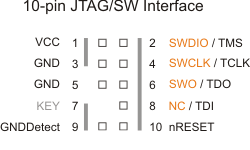
Serial Wire Debug (SWD)
two-pin variant of the JTAG protocol
most common on newer ARM chips
pins:
swdio: in/out
swclk: clock
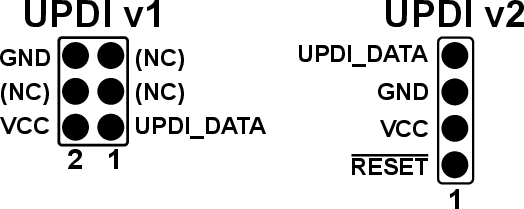
Unified Program and Debug Interface (UPDI)
proprietary
single-wire,
bi-directional, half-duplex
asynchronous
can use off-the shelf UART adapters
used to program AVR microcontrollers released since 2016, ATTINY412, ATTINY164.
more detailed blog article
debugging is hidden behind a proprietary interface, but even though you can snoop on the protocol with just a serial adapter and even though the large scale structure of the protocol is known too
even more detailed article
i did not find out what part of the protocol actually is proprietary and what not.
Difference between microcontroller and -processor
...
