Microprocessors and -controllers

MCU

An MCU is a group of microcontroller units that share a common architecture, design, and often the same core features

  • ARM Cortex-M is a popular MCU family, where multiple manufacturers like STMicroelectronics, NXP, and Microchip produce MCUs that are based on the ARM Cortex-M core.
  • AVR is another MCU family, famously used in the Arduino platform.
  • PIC is a family of MCUs from Microchip Technology, with a range of devices from small 8-bit controllers to more powerful 16-bit and 32-bit versions.

Within each MCU family, you’ll typically see models that differ by features like:

  • Flash memory size
  • RAM size
  • Clock speed
  • Number of GPIO pins
  • Peripheral support (e.g., UART, SPI, I2C, timers, etc.)

In-System Programming (ISP)

  • the act of programming a microcontroller while it is already mounted on the board
  • Contrary to Pre-Programming. You program the contro

CMSIS-DAP Devices are all devices that can write programs into a microcontroller's memory using JTAG or SWD. ler before soldering it somewhere.

Available Controllers

At least 5 of each:

  • SEEEDSTUDIO XIAO SAMD21 NO HDRS
  • SEEEDSTUDIO XIAO ESP32C3 NO HDRS
  • SEEEDSTUDIO XIAO ESP32S3 NO HDRS
  • SEEED STUDIO XIAO RP2040 ARDUINO
  • ATSAMD11C14A-SSUT
  • ATSAMD21E18A-AUT
  • ATTINY412-SSFR
  • ATTINY1624-SSFR
  • ATTINY3226-SU
  • AVR128DB32-I/PT

RP2040 (Raspberry Pi Pico)

Toolchain:

    Primary: Pico SDK (C/C++), CMake Alternatives: Arduino IDE (via Arduino-Pico Core), MicroPython/CircuitPython

    Workflow:

      Write code in C/C++ or Python. Build with CMake (Pico SDK) or Arduino IDE. Flash via USB (UF2 bootloader) or SWD debugger (e.g., Picoprobe).

      Efficiency Tips:

        Use Visual Studio Code with the Pico SDK extension for CMake integration. Leverage Picoprobe (a second Pico) for debugging.

        ESP32 (Espressif)

        Toolchain:

          Primary: ESP-IDF (C/C++), PlatformIO Alternatives: Arduino IDE (via ESP32 Core)

          Workflow:

            Develop in C/C++ (ESP-IDF) or Arduino framework. Build with ESP-IDF CLI or PlatformIO. Flash via USB (esptool.py) or OTA updates.

            Efficiency Tips:

              PlatformIO streamlines ESP-IDF/Arduino workflows. Use ESP-Prog or JTAG for advanced debugging.

              SAMD21/SAMD11 (Atmel/Microchip)

              Toolchain:

                Primary: Atmel/Microchip Studio (C/C++) Alternatives: Arduino IDE (via SAMD Core)

                Workflow:

                  Code in C/C++ (Microchip Studio) or Arduino. Build and flash via USB (UF2 bootloader) or EDBG/SWD.

                  Efficiency Tips:

                    Use Arduino IDE for simplicity; enable verbose upload for debugging. For low-level control, use CMSIS libraries in Microchip Studio.

                    Attiny/AVR128 (AVR Family)

                    Toolchain:

                      Primary: AVR-GCC + AVRdude Alternatives: Arduino IDE (via ATTiny Core)

                      Workflow:

                        Write code in C/C++ or Arduino. Compile with AVR-GCC or Arduino IDE. Flash via ISP programmer (e.g., USBasp, Arduino-as-ISP).

                        Efficiency Tips:

                          Use PlatformIO for project management. For tinyAVR (e.g., ATtiny85), optimize code size with -Os compiler flag.

                          General Workflow Optimization Tips

                            Unified Environments:

                              PlatformIO (VS Code) supports all listed MCUs, reducing toolchain setup time. Arduino IDE (with board managers) simplifies entry-level development.

                              Debugging Tools:

                                SWD/JTAG: Use for RP2040, ESP32, SAMD21 (e.g., Segger J-Link, CMSIS-DAP). Serial Monitor: Essential for ESP32/RP2040 debugging.

                                Version Control:

                                  Use git for code management; track dependencies (e.g., submodules for Pico SDK).

                                  Automation:

                                    Write Makefiles or use PlatformIO scripts for CI/CD pipelines.

                                    QFP mit Beinchen seitlich
                                    TQFP ohne Beinchen
                                    Soic-8 8 Beinchen
                                    Punkt oder Kerbe kennzeichnen Pin 1

                                    Putting code onto it

                                    In-System Programming (ISP)

                                    • the act of programming a microcontroller while it is already mounted on the board
                                    • Contrary to Pre-Programming. You program the contro

                                    CMSIS-DAP Devices are all devices that can write programs into a microcontroller's memory using JTAG or SWD. ler before soldering it somewhere.

                                    Serial Peripheral Interface (SPI)

                                    • A standard synchronous serial communication interface used for short-distance communication between a main device and one or more peripheral devices.
                                    • synchronous (needs clock signal), serial communication
                                    • multiple secondary devices are possible
                                    • full-duplex
                                    • pins:
                                      • MOSI (main out secondary in)
                                      • MISO (main in secondary out)
                                      • SCK (clock)
                                      • SS (secondary select): select which secondary device to communicate with

                                    Serial Peripheral Data Interface (SPDI)

                                    • do not find any source for it

                                    Joint Test Action Group (JTAG)

                                    • eletronics manufacturers committee
                                    • they developed a protocol with the same name
                                    • mostly used for programming ARM cores
                                    • pins
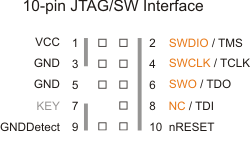
                                      • TMS: mode select
                                      • TCLK: clock
                                      • TDO: data out
                                      • TDI: data in
                                      • nRESET: reset (optional)

                                    Serial Wire Debug (SWD)

                                    • two-pin variant of the JTAG protocol
                                    • most common on newer ARM chips
                                    • pins:
                                      • swdio: in/out
                                      • swclk: clock

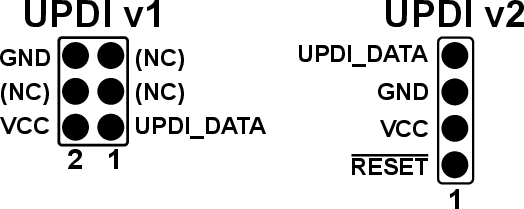
                                    Unified Program and Debug Interface (UPDI)

                                    • proprietary
                                    • single-wire,
                                    • bi-directional, half-duplex
                                    • asynchronous
                                    • can use off-the shelf UART adapters
                                    • used to program AVR microcontrollers released since 2016, ATTINY412, ATTINY164.
                                    • more detailed blog article
                                    • debugging is hidden behind a proprietary interface, but even though you can snoop on the protocol with just a serial adapter and even though the large scale structure of the protocol is known too
                                    • even more detailed article
                                    • i did not find out what part of the protocol actually is proprietary and what not.
                                    Difference between microcontroller and -processor

                                    ...